


Top Regulated Brokers
Data provided by TradingView shows that after a two-day battle at the $80,000 support/resistance level, bears won out, and King Crypto’s price limped lower, with bulls now treading water near the new support level of $76,000.
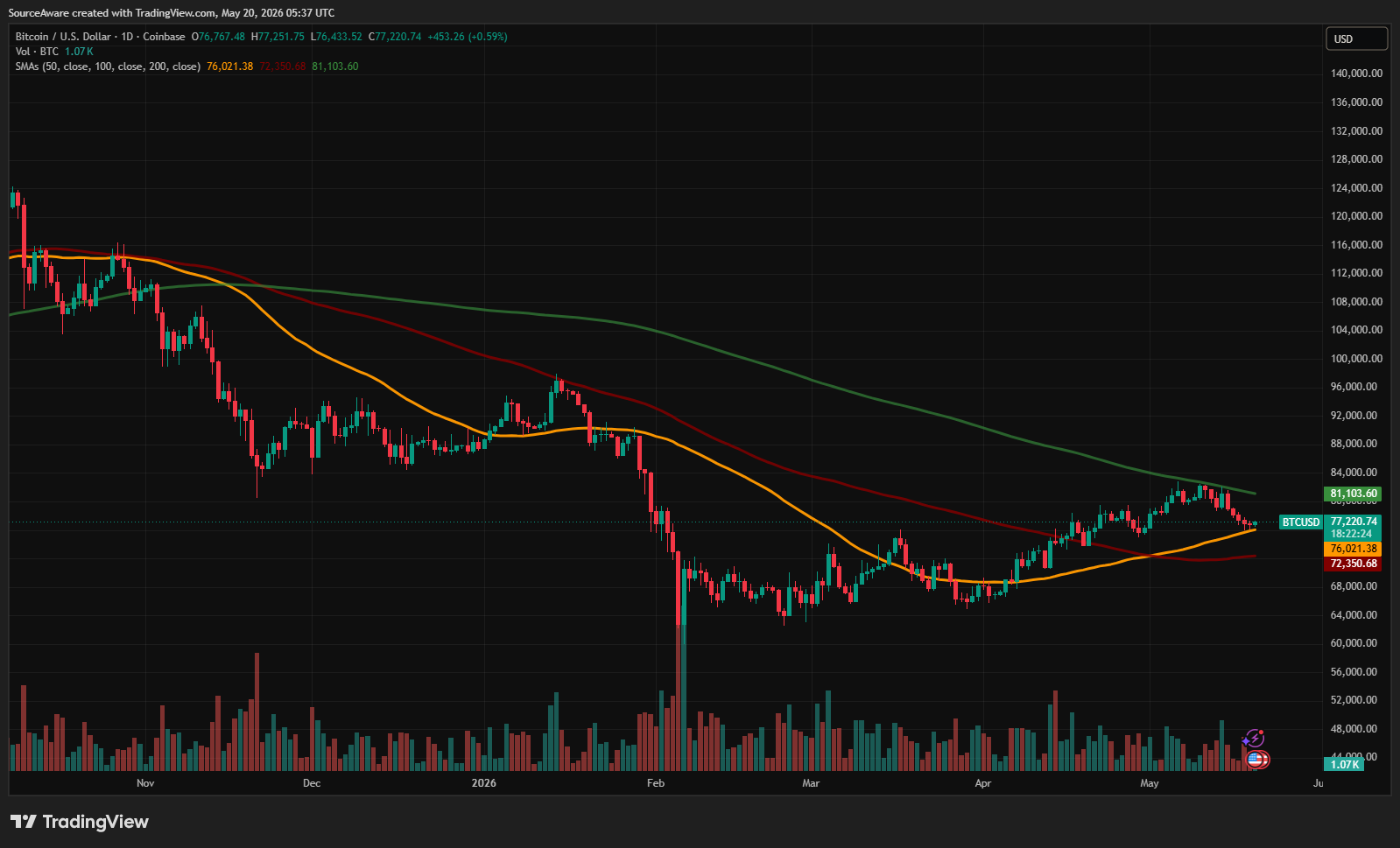
While the 5.5% decline over the past week is not what investors wanted, it is by no means a crash by Bitcoin standards. That said, the jubilant tone of early May has shifted.
Not long ago, the market had been trying to rebuild momentum after pushing back above $80,000. Instead, the latest price action shows that buyers are still hesitant to chase strength when ETF flows weaken and macro conditions become less friendly.
Bitcoin ETF Demand Reverses
The main short-term issue has been the reversal in spot Bitcoin ETF demand. May started off hot, with more than $1.6 billion flowing in through the sixth. Then fortunes turned, outflows dominated, and as of the market close on Tuesday, a total of $713.8 million has exited U.S.-listed spot BTC ETF’s since the beginning of May.
Those numbers matter because ETF flows have become one of the clearest measures of institutional demand for Bitcoin. When the flows are positive, traders can argue that large buyers are absorbing supply. When they turn negative, the market starts asking whether the rally has enough big-player buy-in.
Bitcoin Price Analysis
Bulls' attempts to establish a base in the $80,000 to $82,000 area were rejected. Once the market moved back below that zone, leveraged long positions became vulnerable. Reports of long liquidations in mid-May added to the pressure. This is a familiar pattern in crypto: the first move lower forces some traders out, which then creates more selling and makes the decline look sharper than the original catalyst would justify.
The next important test is whether Bitcoin can stabilize above the $76,000 area and reclaim $80,000. A clean move back above $80,000 would suggest the recent weakness was more of a positioning reset than a deeper breakdown. A failure to hold the mid-$70,000s would make the chart look more vulnerable and could put the next lower support zones back in play.
CLARITY Act Remains the Bigger Policy Story
The price weakness is happening at the same time as one of the more important regulatory developments for the U.S. crypto market: the CLARITY Act.
The Digital Asset Market CLARITY Act is intended to create a clearer federal framework for digital assets. In plain English, it is an attempt to define which crypto assets fall under SEC oversight, which fall under CFTC oversight, and what rules exchanges, intermediaries, developers, and token issuers must follow.
Notably, the Senate Banking Committee advanced the bill on May 14 in a 15-9 vote. The move sparked a brief rally in the crypto market, coinciding with Bitcoin’s battle to hold above $80,000 – but the realization that the bill still has a long way to go before becoming law soon set in, and the momentum died away.
The bill has not passed the full Senate. It still needs to overcome the Senate’s 60-vote threshold, be reconciled with the House version, and then reach the president’s desk. There are also unresolved fights over ethics language, DeFi treatment, stablecoin rewards, banking concerns, and law-enforcement objections.
Analysts are treating the bill as a serious step forward, not a finished deal. Galaxy’s April research described the odds of passage this year as roughly 50-50, with the main risk coming from the number of unresolved issues that still need to be settled under a tight congressional calendar.
Other policy watchers have laid out a best-case path in which the Senate moves quickly, the House accepts or rapidly reconciles the Senate text, and a signing could happen around the White House’s July 4 target.
But the more realistic timeline may be slower. Even if the bill gets signed in 2026, actual enforceable rules will likely depend on SEC, CFTC, and Treasury rulemaking, public comment periods, and compliance phase-ins. That process could push much of the practical market impact into 2027 or beyond.
My Take on Bitcoin and the Clarity Act
For now, Bitcoin’s problem is simple. The policy backdrop is improving, but the flow backdrop has weakened. Until ETF demand stabilizes and Bitcoin gets back above the $80,000 area, rallies may continue to meet selling pressure.
The bigger picture is more balanced. Regulatory clarity in the U.S. would be a major step for the asset class, and the Senate committee vote keeps that possibility alive. But the market is not pricing a finished law yet. It is pricing a bill that has momentum, a tight timeline, and several political fights still ahead.
That is probably the correct posture. Bitcoin traders should watch the $76,000 to $80,000 range in the near term. Crypto investors should watch the Senate floor math. The chart is reacting to flows. The longer-term market structure story is now in Washington’s hands.
At the time of writing, Bitcoin traded at $77,220, a decrease of 4.75% on the 7-day chart.
We hope you enjoyed reading our analysis of what’s going behind the scenes with Bitcoin. If you’d like to trade with one of the best crypto brokers, check out our list.