


The crypto market has been in a downward trend, with more than $1 trillion being wiped out over the last three weeks. Multiple technical signals now confirm the onset of a bear market, often referred to as “crypto winter.” With Bitcoin and the overall market cap showing increasing downward momentum, investors are now pondering strategies to mitigate losses and position for eventual recovery.
Drop Below the 50-Week SMA: Historic Bear Market Harbinger
TOTAL — the combined crypto market capitalization of all cryptocurrencies — has wiped out all the gains it made in 2025. It is down 6.5% over the last week and 20% over the last 30 days. These losses were led by Bitcoin, the biggest cryptocurrency by market capitalization, which has lost 8.7% and 22% of its value over the last seven days and 30 days, respectively.
As a result, BTC has lost key support levels, including the $100,000 psychological level and the 50-week simple moving average (SMA), raising questions about whether the market has entered a full-blown bear market.
The 50-week SMA is a key technical indicator that smooths out price data over approximately one year, providing a long-term trend line for assets like Bitcoin.
Recently, both Bitcoin's price and the total crypto market capitalization have fallen below this critical level. This breach is significant because the SMA acts as a dynamic support; when prices dip below it, it often signals a shift from bullish to bearish sentiment, reflecting sustained selling pressure from both institutional and retail investors.
Historically, this indicator has been a reliable precursor to prolonged downturns. For instance, in previous cycles such as the 2018 bear market, TOTAL’s drop below the 50-week SMA preceded a staggering 72% decline in its value over the following months. Similarly, during the 2022 crypto winter, a comparable breach resulted in a 66% drawdown, wiping out trillions of dollars in market value across the ecosystem.
TOTAL/USD weekly chart. Source: TradingView
Additional data shows that when the BTC/USD pair dropped below its 50-week SMA in 2018 and 2022, it was followed by 62% and 72% price drawdowns, respectively.
External factors like regulatory crackdowns, macroeconomic tightening, and overleveraged positions in derivatives markets exacerbated these events. Analysts note that the current drop mirrors these patterns, with onchain data indicating increased panic-selling by short-term holders and reduced whale accumulation, further confirming weakened demand.
Bitcoin’s SuperTrend Indicator Projects a 77% Price Drop
Bitcoin’s SuperTrend indicator has sent a “sell” signal on its weekly chart, an occurrence that has historically marked the start of a bear market.
The Supertrend indicator is a volatility-based tool that combines price action with the Average True Range (ATR) to plot a trailing stop line, helping traders identify trend reversals.
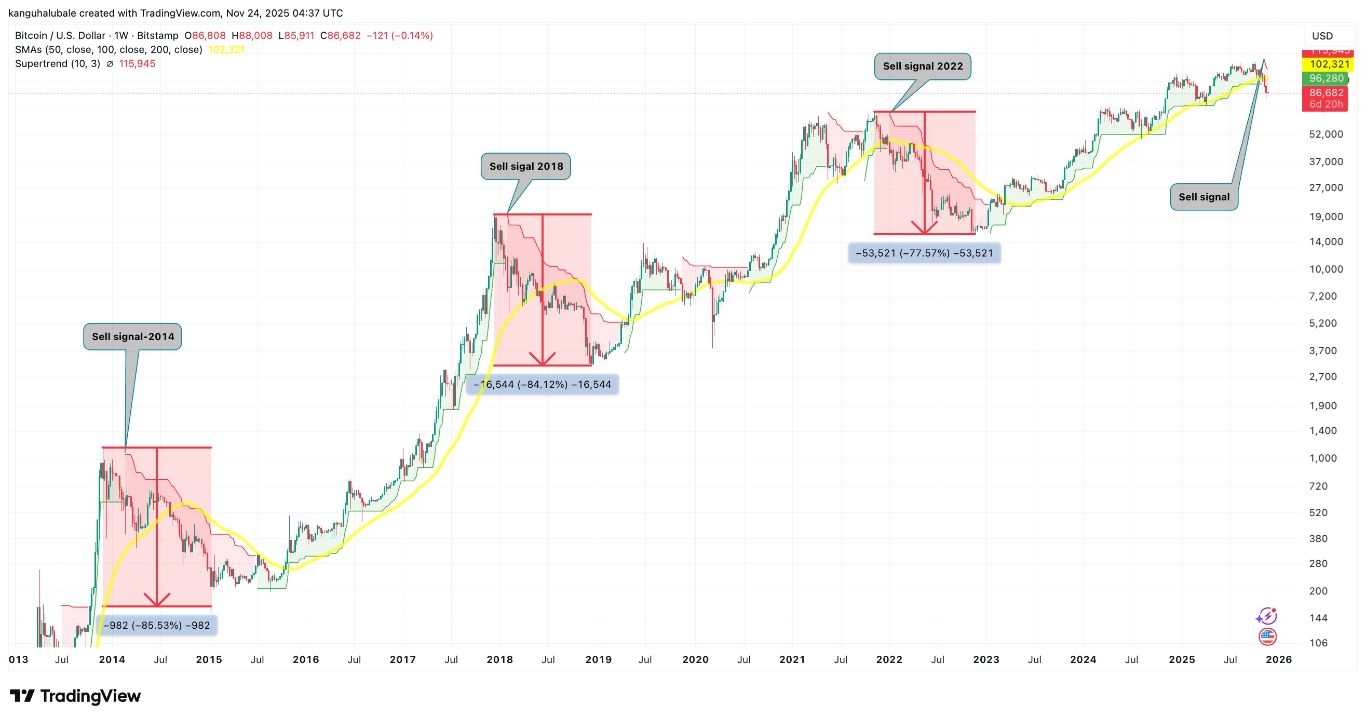
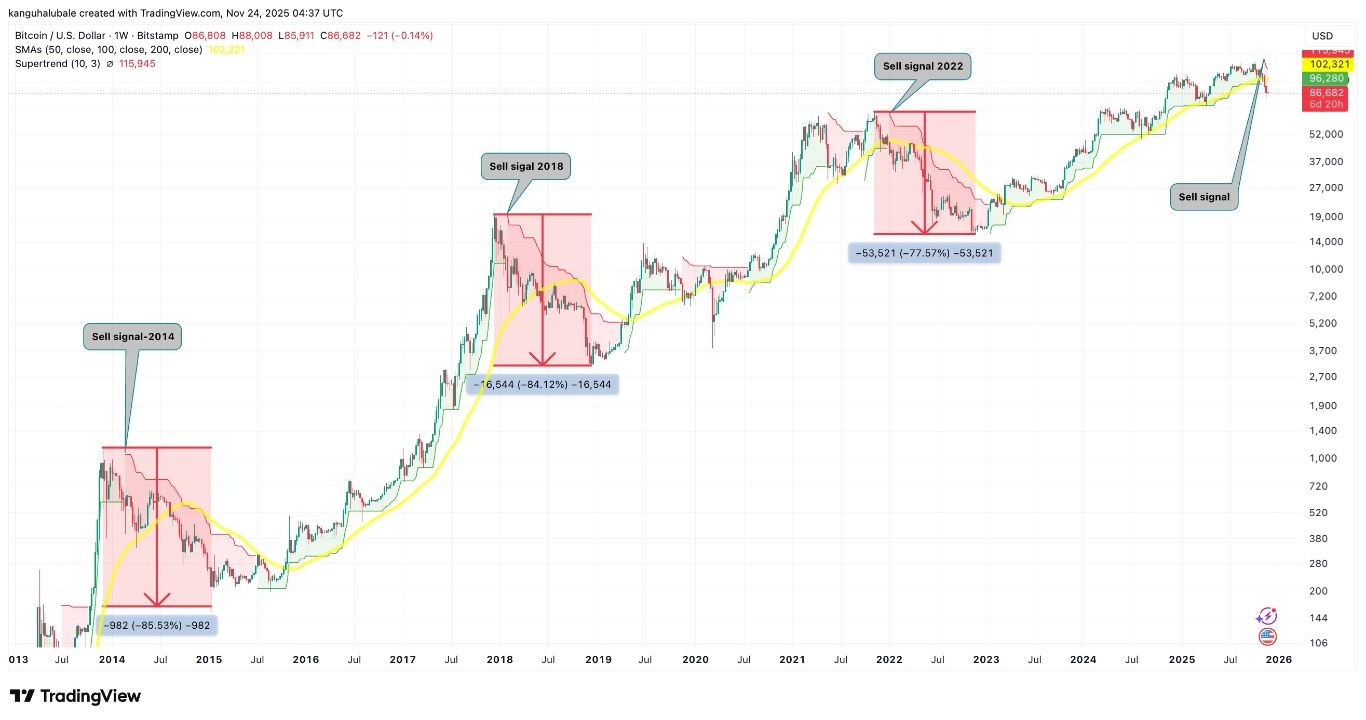
The weekly chart below shows that the SuperTrend indicator flashed a bearish signal when it reversed from red to green and moved above the price last week.
The SuperTrend’s “sell” signal was confirmed after the BTC/USD pair produced a weekly close below the 50-week SMA on Nov. 16, a scenario that has historically marked the end of a bull market.
Previous confirmations from these two indicators were followed by 86%, 84% and 77% drawdowns during the 2014, 2018 and 2022 bear markets, as shown in the chart below.
BTC/USD weekly chart. Source: TradingView
“The SuperTrend indicator on the weekly chart has a long history of correctly signaling major trend shifts,” said crypto analyst Ali Martinez in an X post on Monday, adding:
“Each time it turns bearish, Bitcoin $BTC tends to follow with a sizable correction.”
If history repeats itself, BTC could see a massive downward move, with analysts saying that the price could go as low as $50,000, driven by persistent outflows from US-based spot ETFs, decreased demand from Bitcoin treasury companies and selling by long-term whales.
Bitcoin’s Death Cross Echoes of 2022’s Drawdown
Bitcoin’s entry into a bear market has also been confirmed by the appearance of a death cross on the daily chart, a technical indicator that has previously preceded significant price declines.
This occurred on Nov. 16 when the 50-day SMA crossed below its 200-day SMA, forming a death cross.
The last significant death cross happened in January 2022, just before a brutal 64% drawdown in Bitcoin's price amid the Terra-Luna collapse, FTX scandal, and Federal Reserve rate hikes. That period saw the total crypto market cap plummet by over 70%, illustrating how the death cross often amplifies existing vulnerabilities like high leverage and speculative fervor.
“Every Bitcoin cycle has ended with a Death Cross,” said analyst Mister Crypto in an X analysis last week, adding:
“Why would this time be different?”
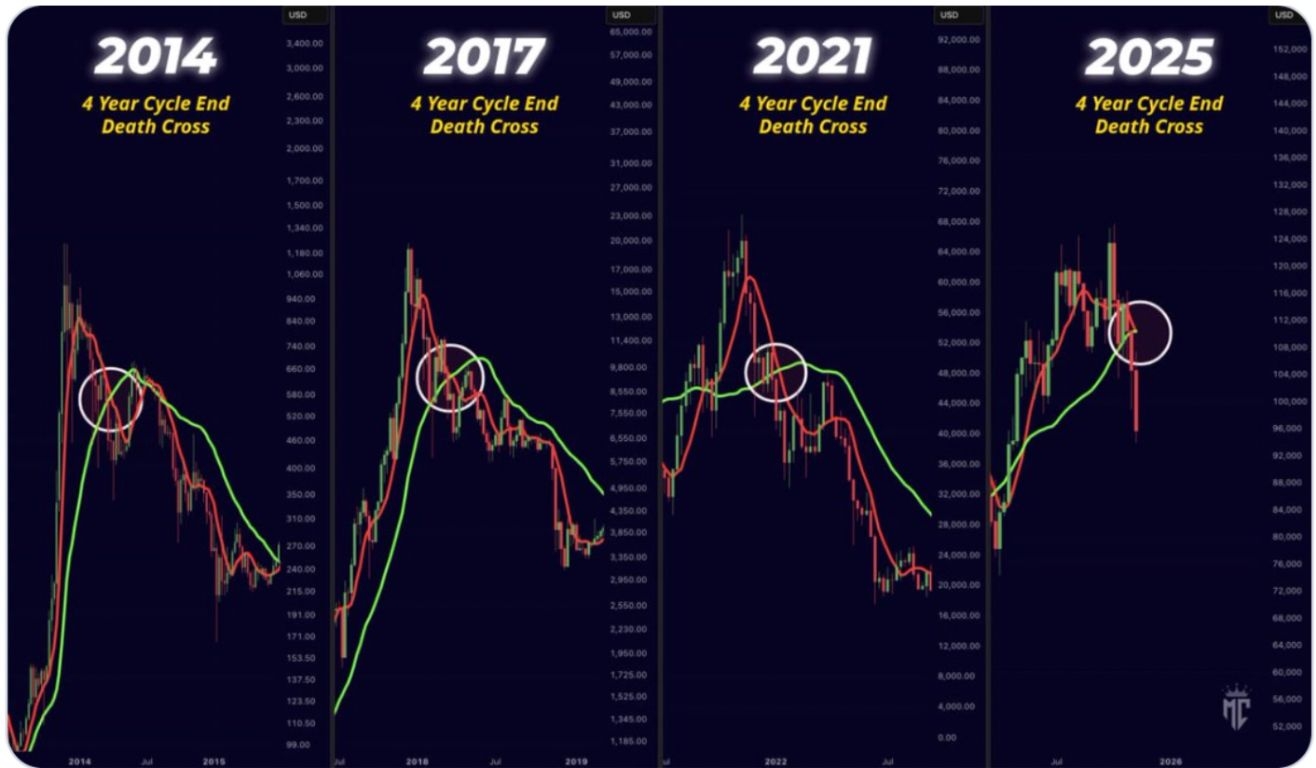
Bitcoin’s past performance after a death cross. Source: Mister Crypto
Similar confirmations in March 2018 and September 2014 saw 67% and 71% declines in BTC price, respectively.
My Take
Multiple reliable technical signals — 50-week SMA breach, a call to “sell” from the weekly Supertrend indicator, and daily death cross — confirm Bitcoin and crypto have entered a new bear market. This implies that a prolonged downside is likely ahead, and investors should prioritize capital preservation, selective accumulation at lower levels, and patience for the eventual recovery of the cycle.
Ready to trade our analysis of Bitcoin? Here’s our list of the best MT4 crypto brokers worth checking out.