


The Euro faces a structural tension: strength rooted in carry-trade positioning collides with safe-haven repricing when central bank guidance shifts unexpectedly. Kevin Warsh's recent commentary on Federal Reserve monetary policy has exposed a vulnerability in the consensus for dollar weakness, triggering an immediate reassessment of whether the Fed will sustain higher rates longer than markets anticipated. USD/JPY's consolidation near the 160 Yen level signals a broader institutional rotation. The anti-US dollar consensus has fractured, and positioning asymmetry now defines near-term risks.
Top Regulated Brokers
Context / Why This Matters Now
The backdrop for this move hinges on the divergence between market expectations and Federal Reserve messaging. For weeks, traders positioned for US rate cuts starting in the spring, a narrative supported by softening inflation data and Fed communications. Warsh's comments marked a pivot in that consensus: he signaled the Fed's door remains open to tightening should inflation resurface, a stance that caught many carry traders off guard. Bond markets reacted sharply, with US Treasury yields jumping and repricing the entire 12-month rate path. This divergence masks a deeper vulnerability: consensus assumes US economic resilience guarantees higher-for-longer rates, yet market positioning remains crowded on the anti-dollar trade. Geopolitical tensions and Middle East supply risks add further uncertainty, leaving traders caught between competing narratives of recession risk and persistent inflation.
Technical Structures and Institutional Commitment
EUR/USD has broken below its 200-day exponential moving average, a level that has historically anchored intermediate-term support and served as a behavioral threshold for position traders. The breakdown suggests institutional selling pressure remains committed. Volume patterns show methodical seller participation, and momentum divergence (price making lower highs while oscillators flatten) signals waning conviction on the upside. The technical setup now hinges on whether buyers can defend the 200-day EMA as a ceiling or whether a lower close definitively confirms the downtrend. Higher US Treasury yields drive this repricing by making dollar-funded carry trades less attractive relative to rate-hedged positioning. If sellers maintain discipline below the moving average, the next technical bottleneck emerges around the 1.16 zone, where either stabilization or accelerated selling would clarify institutional intent for the next 2 to 4-week cycle.
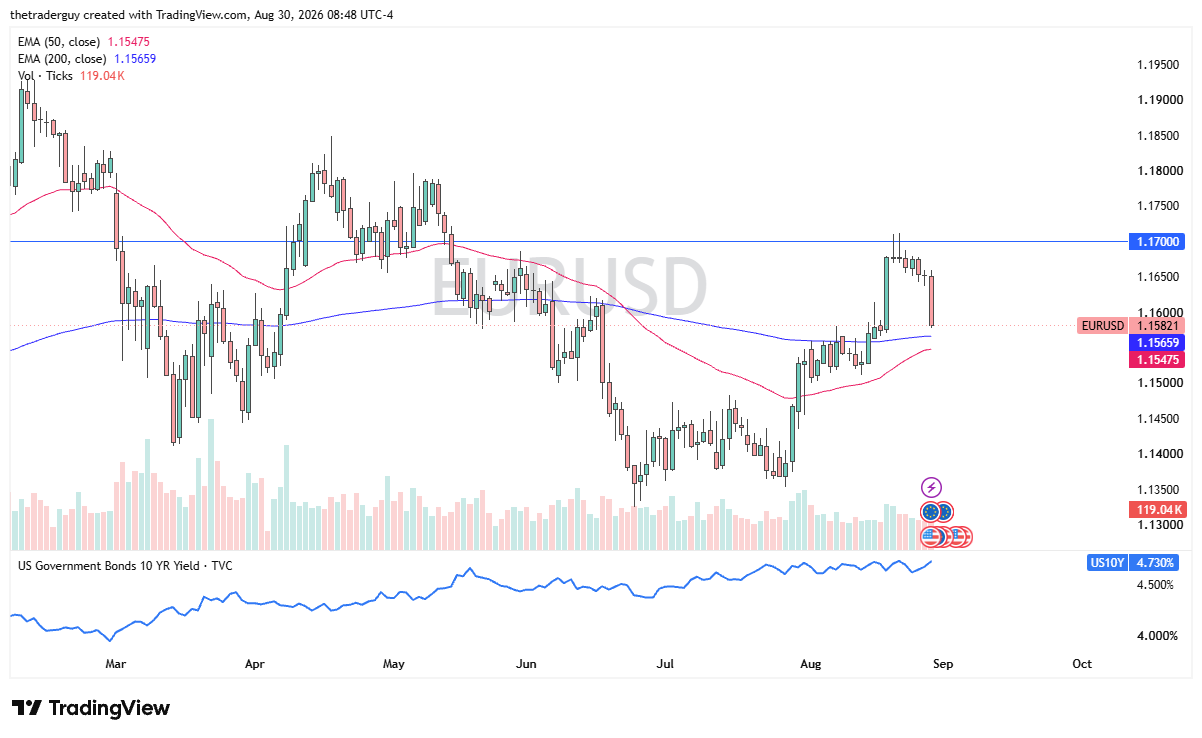
EUR/USD Price Chart
The Consensus Blind Spot: Why Market Positioning May Mask Fragility
The market's confidence in higher-for-longer US rates rests on a foundation of assumed economic resilience, yet this consensus underestimates how quickly credit stress and yield curve inversion can reverse Fed hawkishness. Traders have crowded into anti-dollar positioning based on the belief that US growth will remain robust enough to force the Fed to maintain elevated rates, but this narrative ignores the lag between financial stress and policy response. Historical precedent suggests that once yield curve inversion persists beyond 12 months (a condition now present), recession probability rises sharply, and the Fed typically pivots dovish within quarters, not years. Additionally, the positioning asymmetry in EUR/USD means that a modest catalyst—a weaker US jobs report or a credit event—could trigger rapid position unwinding that amplifies the euro's downside move beyond what technical analysis alone would suggest. The blind spot is institutional complacency about the speed of policy reversal once economic data confirms recession risk.
H2 When the Thesis Breaks: Invalidation Levels and Catalysts
The primary thesis—that Fed tightening bias will sustain dollar strength into the 200-day EMA—hinges on continued US inflation resilience and institutional recognition of that resilience by bond markets. The thesis breaks decisively if EUR/USD rallies and holds above 1.18 on a daily close, signaling buyer commitment strong enough to overcome the yield repricing; this outcome would suggest market participants believe the Warsh pivot is temporary or overstated. Conversely, a break below 1.15 on a daily close would confirm accelerated institutional selling and likely trigger algorithmic follow-through toward 1.13–1.14 support zones, validating the downtrend for another 4 to 6-week cycle. The secondary invalidation comes from inflation data: should the next CPI or PCE print surprise to the downside and bond yields fall 30+ basis points in a single session, the Fed tightening narrative weakens, and the anti-dollar trade regains momentum. Watch the USD/JPY pair as a secondary confirmation signal; a decisive break above 161 or below 158 yen would indicate whether the positioning rotation is sustained or reversing.
Warsh's comments on Fed tightening signals have catalyzed a sharp unwind of crowded anti-dollar positioning, with EUR/USD now consolidating near its 200-day exponential moving average and testing a critical behavioral zone. The repricing reflects a divergence between market consensus for rate cuts and Fed messaging on the potential for higher rates, a friction that will likely persist through the next inflation data release. Watch whether the 200-day EMA holds as institutional resistance into the European open this week; a daily close below that level would confirm the downtrend, while a decisive recovery above 1.18 would signal that the yield repricing has exhausted its selling pressure.
Ready to trade our EUR/USD analysis? Here is our list of the best brokers worth checking out.