


King Crypto has avoided a deeper sell-off despite one of the largest reported security breaches in the history of the crypto industry. The October 29 attack on Binance, the world’s largest crypto exchange by trading volume, involved approximately $6.3 billion in unauthorized transactions and forced the platform to temporarily suspend withdrawals. BTC/USD subsequently fell toward $76,000 before recovering near $78,000, raising questions about why the market has remained relatively resilient. The incident exposed vulnerabilities in centralized exchange infrastructure, but it has not triggered the widespread panic selling that some traders might have expected.
Top Regulated Brokers
Binance’s commitment to covering the affected assets and its phased restoration of withdrawals have helped contain immediate concerns about customer losses. Meanwhile, Bitcoin exchange outflows have increased, suggesting investors are moving coins away from trading platforms. However, the picture is not entirely bullish: US spot Bitcoin ETFs recorded $643.3 million in net outflows on October 30. The contrast between exchange withdrawals and weaker institutional demand leaves traders weighing whether Bitcoin has absorbed the shock or faces another test of support.
Binance Resumes Withdrawals After the $6.3 Billion Security Breach
Binance has begun restoring withdrawals following a security breach that resulted in approximately $6.3 billion in unauthorized transactions involving its hot wallet infrastructure. The attack occurred around 20:05 UTC on October 29, with most of the funds reportedly moved within approximately 20 minutes. Binance subsequently suspended withdrawals while investigating the incident and securing its systems.

Binance incident update. Source: Binance/X
According to Reuters, attackers compromised Binance’s transaction-signing infrastructure, allowing them to authorize unauthorized withdrawals. The exchange initially suspected a compromised employee laptop but later identified additional points of compromise. Binance has not publicly identified the perpetrators. Although analysts have noted similarities to operations attributed to North Korean hackers, no confirmed attribution has been announced.
The breach raised concerns about customer asset security and the possibility of wider contagion across crypto markets. Binance, however, assured users that they would not bear the financial losses. In its October 30 security update, the exchange said it had allocated more than $6.34 billion through its Secure Asset Fund for Users (SAFU) and corporate treasury to cover the affected assets. It also reported that approximately $3 billion had been frozen onchain through cooperation with law enforcement, blockchain intelligence firms and token issuers. Binance said it had found no evidence that wallet private keys were leaked.
The recovery process has since progressed. Binance reported on October 31 that it had replenished approximately 90% of the affected assets, with BTC, ETH, USDT, BNB and SOL among the major assets fully backed. On November 1, the exchange began restoring withdrawals in phases, initially supporting 15 networks and assets.
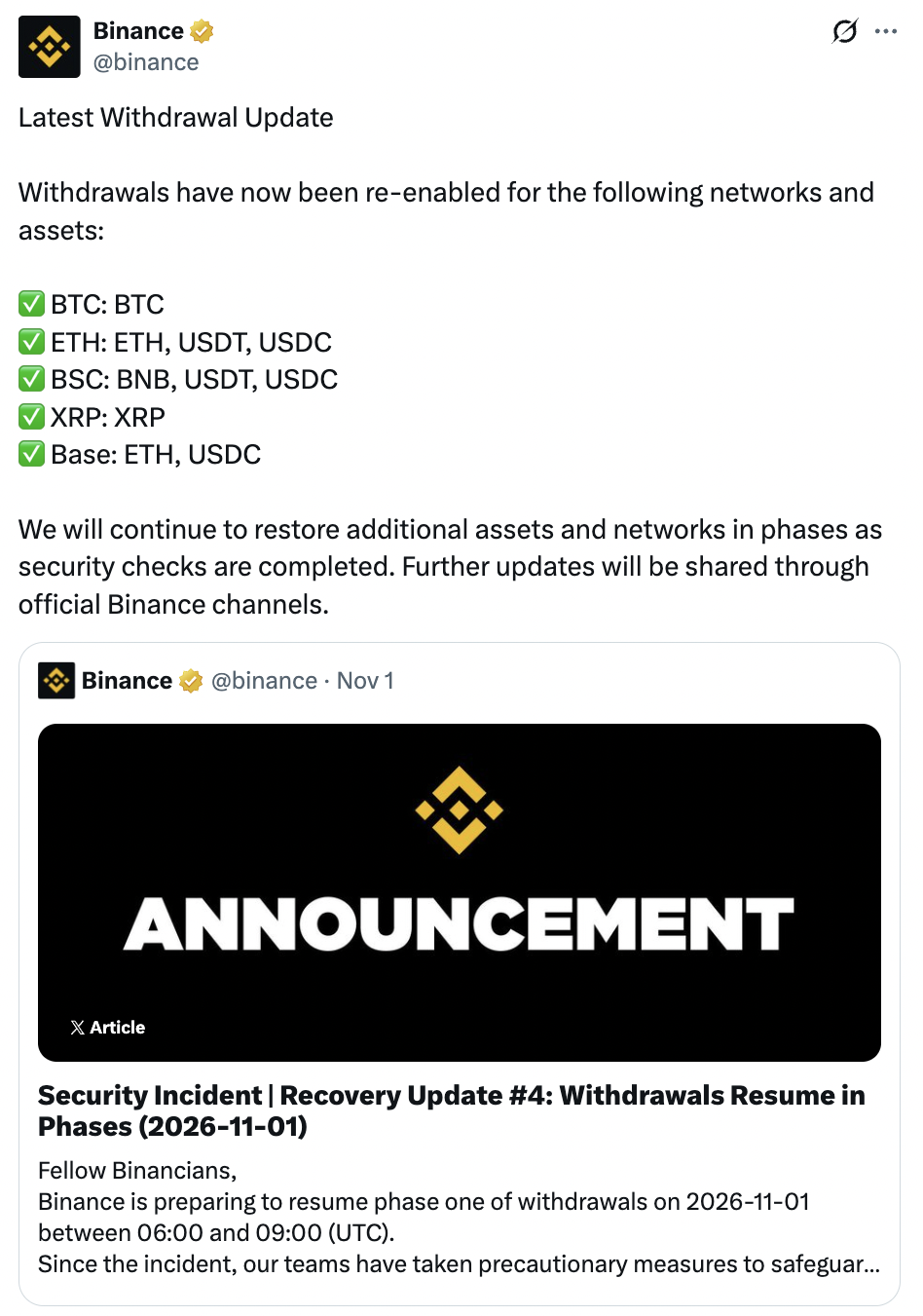
Binance incident update. Source: Binance/X
Binance also reported processing $4.649 billion in withdrawals and $1.01 billion in deposits during the initial restoration period, resulting in net outflows of approximately $3.64 billion. It said this represented 2.1% of its $171 billion in assets under management. The exchange continues to work with industry partners and law enforcement to trace and recover stolen funds.
These measures help explain Bitcoin’s relative resilience. Binance’s commitment to covering the losses, freezing affected assets and restoring withdrawals has reduced fears that customers would face immediate losses. Nevertheless, the investigation remains incomplete, and the exchange has yet to publicly establish who was responsible or disclose the full attack sequence. The incident remains a significant test of confidence in centralized exchanges (CEXs).
Bitcoin Exchange Outflows Increase Following the Attack
Bitcoin experienced renewed selling pressure following the Binance incident, briefly falling toward $76,000 on Friday before recovering near $78,000. However, exchange-flow data suggests that investors have also been withdrawing BTC from trading platforms.
According to data from CryptoQuant, Bitcoin exchanges recorded 30,435 BTC in net outflows between October 25 and October 31, compared with net inflows of 3,434 BTC during the previous week. The report identified 23,790 BTC in outflows on October 29 alone.
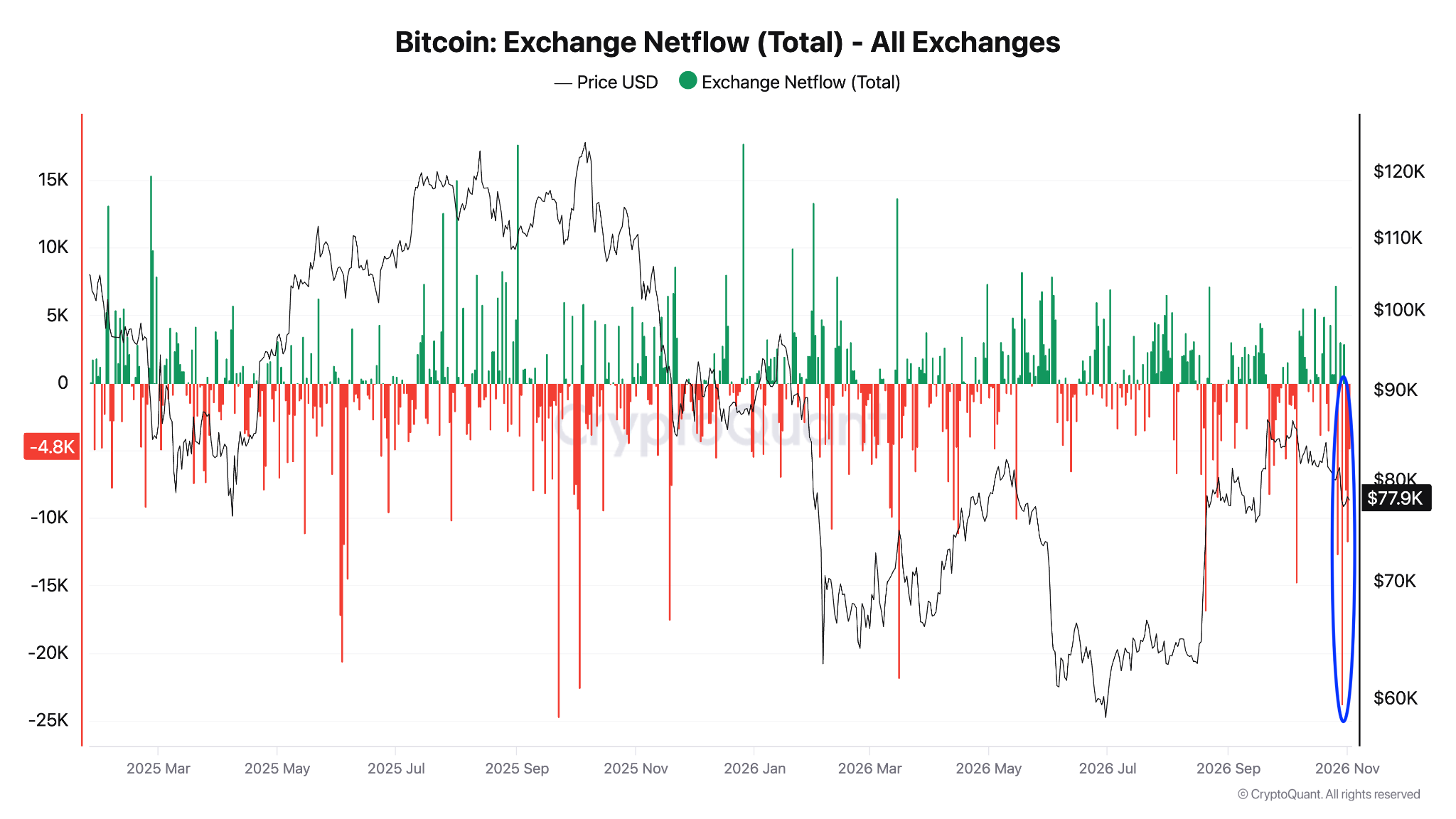
Bitcoin exchange netflow. Source: CryptoQuant
The data also shows substantial negative flow spikes around the end of October. Its latest displayed netflow reading is approximately negative 4,800 BTC at the time of writing, while Bitcoin trades near $77,900. Negative netflows indicate that more BTC is leaving exchanges, as users send their coins to self-custody wallets.
Such withdrawals can reduce the amount of Bitcoin immediately available for sale on trading platforms, potentially easing selling pressure. However, they do not automatically confirm accumulation. The Binance breach may have encouraged customers to move assets into private wallets for security reasons rather than because they expect prices to rise. The distinction matters when interpreting the latest outflows as a bullish signal.
Spot ETF flows provide another reason for caution. US-listed spot Bitcoin ETFs recorded approximately $643.3 million in net outflows on October 30, according to data from SoSoValue. This was the largest single-day withdrawal since June 25, when outflows reached $696.3 million. BlackRock’s IBIT and Fidelity’s FBTC led the latest withdrawals, losing approximately $233.7 million and $201.4 million, respectively.
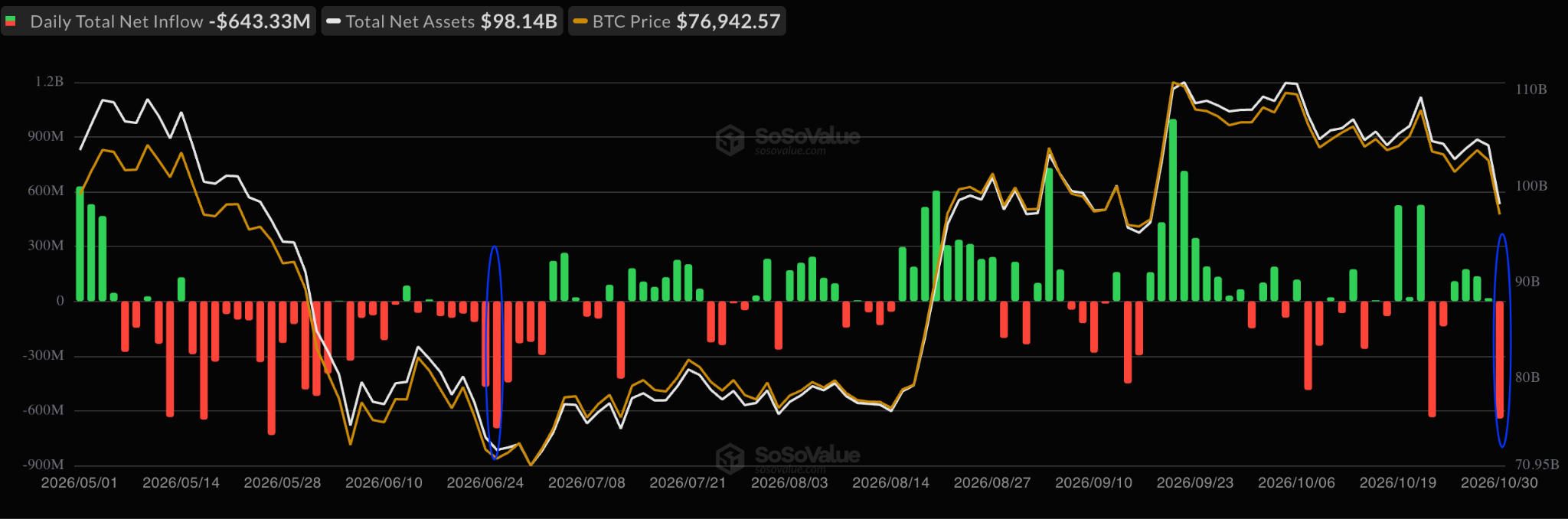
Spot Bitcoin ETF flows chart. Source: SoSoValue
While investors are moving BTC away from exchanges, institutional demand through regulated investment products has weakened sharply. Persistent exchange outflows could support prices if they reflect longer-term holding behaviour, but continued ETF redemptions could offset that effect. Bitcoin needs stabilizing fund flows and sustained spot demand to turn the latest withdrawals into a convincing bullish signal.
Bitcoin’s 50-Week Moving Average Holds as $70,000 Becomes Key
Despite the Binance breach and ETF outflows, Bitcoin has maintained an important part of its longer-term technical structure.
“Bitcoin closes above its 50-week moving average for 7th straight week despite $6b+ hack on world’s biggest crypto exchange,” Head of Firmwide Research Alex Thorn said in an X post on Monday, adding:
“Great to see BTC’s resilience and ability to keep the current technical market structure intact.”
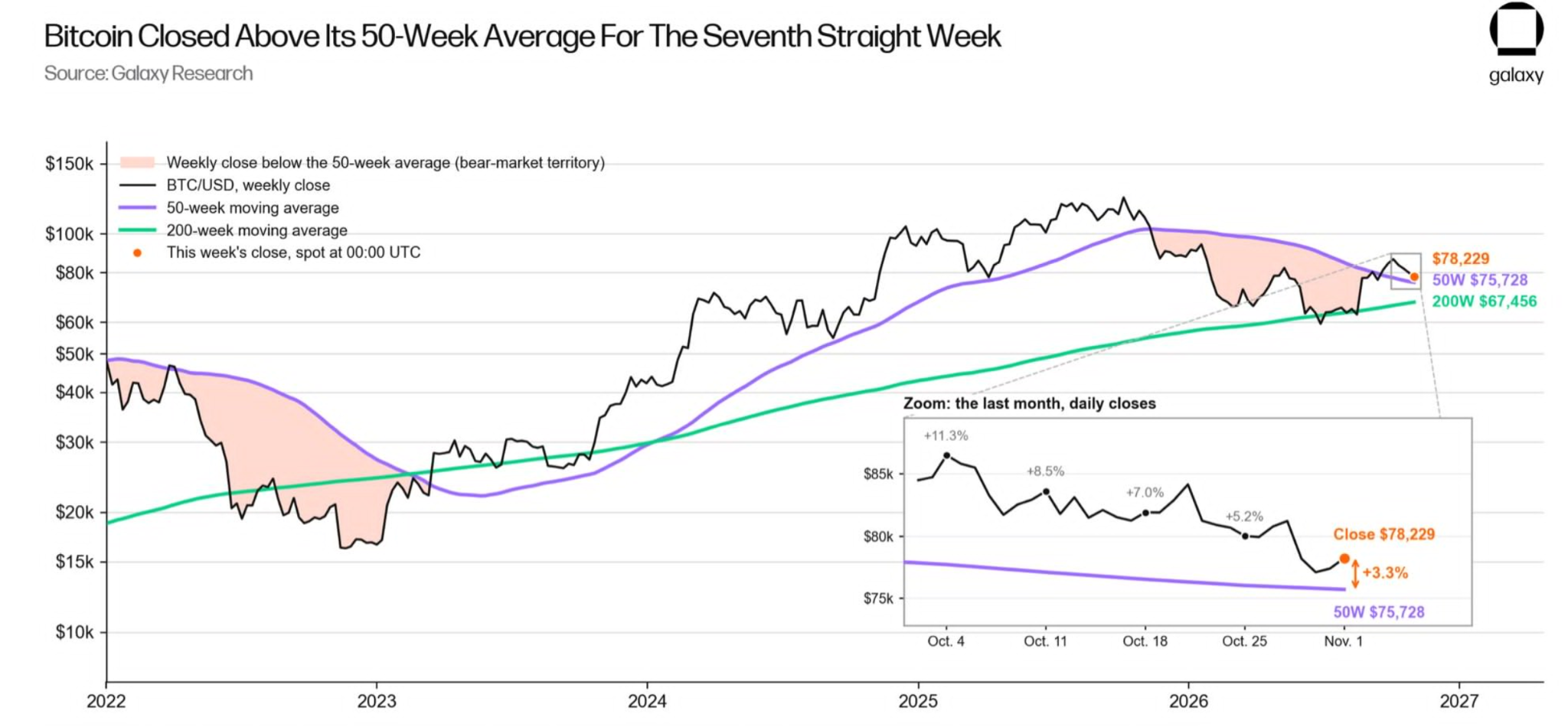
BTC/USD chart. Source: Alex Thorn
The 50-week moving average is a widely watched measure of Bitcoin’s intermediate-to-long-term trend. Holding above it suggests that buyers continue to defend an important technical reference point, even as short-term sentiment weakens. This does not eliminate downside risk, but it indicates that the Binance incident has not yet forced a decisive breakdown in the broader structure.
The next challenge is maintaining support around the 50-week average as Bitcoin trades near $78,000. A sustained recovery, supported by stronger spot demand and improving ETF flows, would reinforce the bullish structure. Conversely, a weekly close below the 50-week moving average would weaken the outlook and expose BTC to further losses.
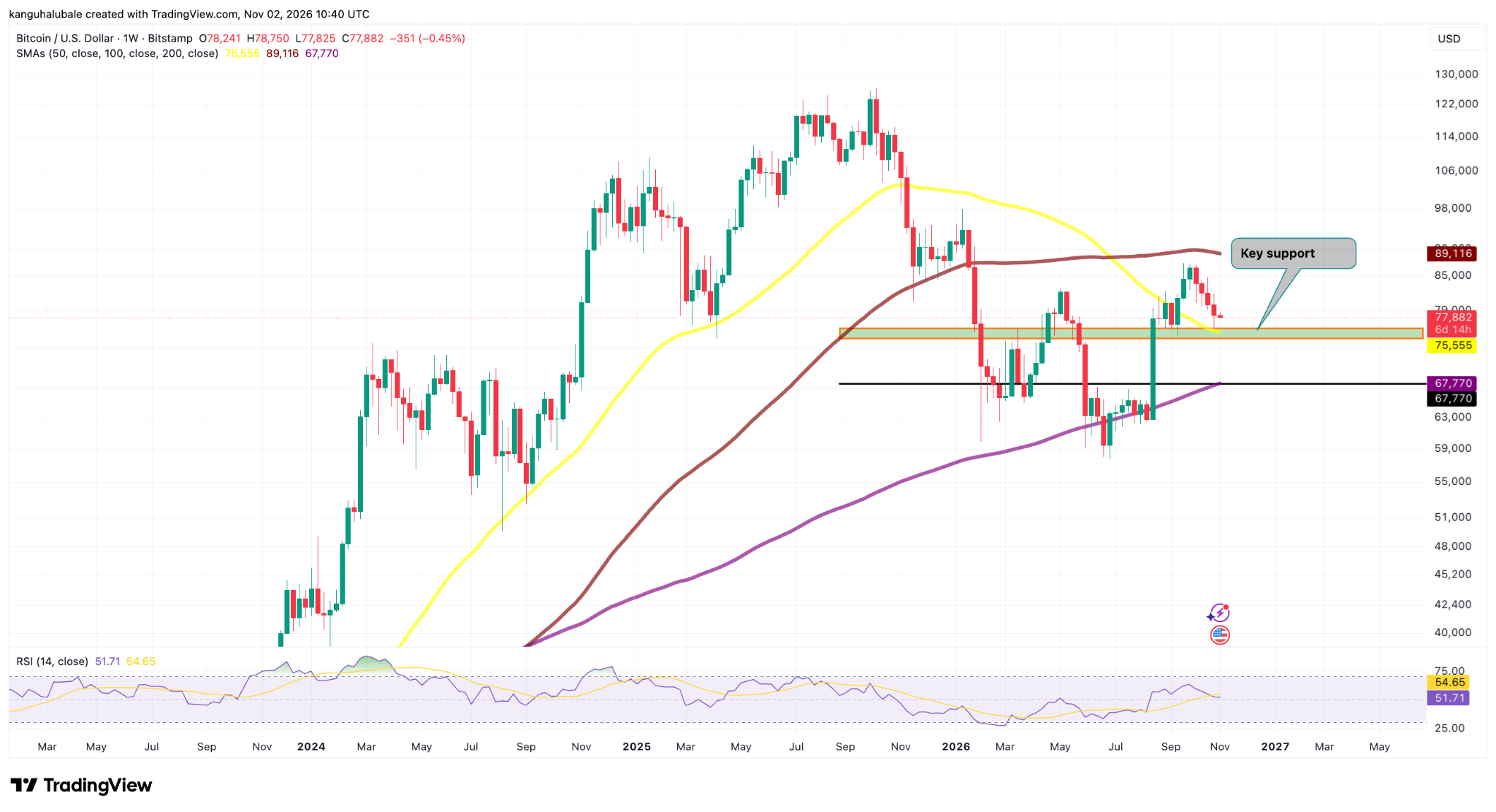
BTC/USD weekly chart. Source: TradingView
The $70,000 psychological level would then become an important downside reference. Below it, the 200-week moving average near $68,000 could provide a deeper buffer zone.
What Does This Mean for the BTC/USD Price?
I am cautiously neutral to bullish while Bitcoin holds above its 50-week moving average. Binance’s commitment to covering the stolen assets and its phased restoration of withdrawals have helped contain the immediate confidence shock. The substantial exchange outflows may also reduce readily available selling supply. However, the $643.3 million ETF withdrawal shows that institutional demand remains a significant weakness.
Bitcoin’s next move will depend on whether the market can absorb the security shock without losing its longer-term support. Persistent exchange outflows accompanied by stabilizing ETF flows would strengthen the recovery case. Continued fund redemptions and a weekly close below the 50-week average would instead increase the risk of a decline toward $70,000 and potentially $68,000. For now, resilience near $78,000 is encouraging, but buyers still need to demonstrate sustained demand.
Ready to trade our analysis of Bitcoin? Here’s our list of the best MT4 crypto brokers worth checking out.